Posts

Showing posts with the label Rilke

Rilke's Prose (via Stephen Mitchell)

Have been reading some selected prose pieces of Rilke. Thought I'd start there and then reread Duino. Anyway, don't think I've ever come across this piece before: seemingly written in response to some Christian group. Much of it is interesting; much of it nebulous (like a lot of Rilke). I suppose the part that tickled me most is the part where he compares the sexuality of an adult (centered you know where) and the sexuality of a child (according to Rilke and his friend: scattered throughout the child's body). * An excerpt: The terrible untruth and uncertainty of our time has its foundation in our not acknowledging the happiness of sex, in this strangely mistaken guiltiness, which continually increases, and cuts us off from all the rest of Nature, even from the child, although, as I learned during that unforgettable night, his, the child's, innocence doesn't at all consist in the fact that he, so to speak, doesn't know sex,--"on the contrary,...

Leonid Pasternak (1862 - 1945)

Leonid Osipovich Pasternak (born Yitzhok-Leib , or Isaak Iosifovich, Pasternak ; Russian : Леони́д О́сипович Пастерна́к , 3 April 1862 N.S. – 31 May 1945) was a Russian post-impressionist painter . He was the father of the poet and novelist Boris Pasternak . Biography Leonid Pasternak was born in Odessa to an Orthodox Jewish family on 4 April 1862. The family claimed to be distantly descended, in one line, from Isaac Abrabanel , the famous 15th-century Jewish philosopher and treasurer of Portugal, although no independent evidence of this exists. [ 1 ] Leonid's father made an income by renting out a guest house. The courtyard of the guest house, with its adjoining coach-house, first awakened Leonid's artistic imagination. He was the youngest of the six children in the family. He started to draw very early, but his family tried to discourage him, as they feared that his drawing would interfere with his studies. His first sponsor was the local street cleaner who began bu...

As Close as I Got to Duino...

Image
Traveled to Trieste just for Duino (it's still a school, I believe -- I met a young man near a seaside grotto who attended the school). Walked miles in the pouring rain. Loved every minute of it. Swear I heard an angel or two myself. *     

From Rilke's Tenth Elegy

Last two strophes of the Tenth Elegy (German/English):   Aber erweckten sie uns, die unendlich Toten, ein Gleichnis, siehe, sie zeigten vielleicht auf die Kätzchen der leeren Hasel, die hängenden, oder meinten den Regen, der fallt auf dunkles Erdreich im Frühjahr. –   Und wir, die an steigendes Glück denken, empfänden die Rührung, die uns beinah bestürzt, wenn ein Glückliches fällt.   ***   But if the endlessly dead woke a symbol in us, see, they would point perhaps to the catkins, hanging from bare hazels, or they would intend the rain, falling on dark soil in Spring-time. –   And we, who think of ascending joy, would feel the emotion, that almost dismays us, when a joyful thing falls.   [Translation by A. S. Kline]  

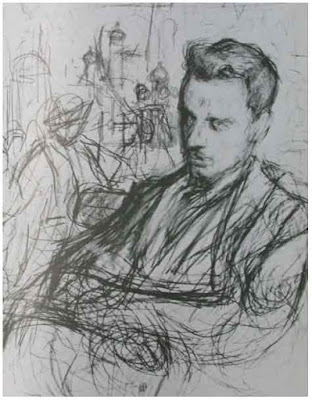
Sketch of Rilke by Leonid Pasternak

Image
  [From Wikimedia Commons: https://commons.wikimedia.org/wiki/File:Pasternak-rilke.jpeg ] 

Duino Elegies

The Duino Elegies ( German : Duineser Elegien ) are a collection of ten elegies written by the Bohemian - Austrian poet Rainer Maria Rilke (1875–1926). Rilke, who is "widely recognized as one of the most lyrically intense German-language poets," [ 1 ] began writing the elegies in 1912 while a guest of Princess Marie von Thurn und Taxis (1855–1934) at Duino Castle , near Trieste on the Adriatic Sea . The poems, 859 lines long in total, [ 2 ] were dedicated to the Princess upon their publication in 1923. During this ten-year period, the elegies languished incomplete for long stretches of time as Rilke suffered frequently from severe depression —some of which was caused by the events of World War I and being conscripted into military service. Aside from brief episodes of writing in 1913 and 1915, Rilke did not return to the work until a few years after the war ended. With a sudden, renewed inspiration—writing in a frantic pace he described as a "boundless storm, a...

Scholem on Benjamin

Three clips: The origin of the constellations as configurations on the sky surface was, so he asserted, the beginning of reading, and writing, and this coincided with the development of the mythic age. The constellations were for the mythic world what the revelation of Holy Writ was to be later. *** Buschor had spoken about the archaic torso of Apollo in the museum at Naples and at the end of his lecture had recited Rilke's poem by that title, whereupon he burst into tears -- not an everyday occurrence in an academic lecture on archaeology. I told Benjamin about this, and he said, Yes, it really is an extraordinary poem. *** This is when I first noticed Benjamin's basic melancholy, the incipient depressive traits that later became more pronounced. (I never noticed anything manic about him.) At the same time I began to grow aware of the hysterical elements in Dora's behavior, which were sometimes suddenly triggered by the most insignificant events. Often eno...

Rilke's "Widening Circles"

I've got Bly's translation somewhere (I won't dig), and Mitchell didn't seem to include it (it's from Rilke's Book of Hours ). I'm 99% certain I've looked at the translation myself at one time or another (I was never quite satisfied with capturing the end of strophe one). Anyway, found myself thinking of it twice today: in reference to human possibilities (I had a certain someone in mind here) and also a friend who doesn't know Rilke. * I live my life in widening circles that reach out across the world. I may not complete this last one but I give myself to it. I circle around God, around the primordial tower. I've been circling for thousands of years and I still don't know: am I a falcon, a storm, or a great song? [Translation by Joanna Macy and Anita Barrows]

Kafka and Rilke

Kafka remarking (in a letter) on Rilke's words re Kafka's work: Incidentally, back in Prague I remembered Rilke's words. After some extremely kind remarks about "The Stoker," he went on to say that neither Metamorphosis nor "In the Penal Colony" had achieved the same effect. This observation may not be easy to understand, but it is discerning. The footnote on this passage reads (in part): Rilke and Kafka probably never met personally. Kafka may have heard of Rilke's opinion about his works through Eugen Mondt. Since "In the Penal Colony" was not printed at the time, Rilke, who then lived in Munich, must have seen the manuscript which had arrived in Munich on September 30 and discussed it with Eugen Mondt....   Rilke followed Kafka's work with great interest; in a letter to Kurt Wolff of February 17, 1922, he says, "Please put me down especially for anything that appears by Franz Kafka. I am, I might assure you, not his ...

Rilke's "Requiem for a Friend"

Surprised I hadn't put this up long ago. Guess it's because there are so few translations on the Net and I didn't want to copy it out? Not sure. Anyway, I was thinking of this this morning and had to post it. It was written for Rilke's friend, the painter Paula Modersohn-Becker (I have been to her grave and her husband's museum). This translation is by A.S. Kline (2001); I have a copy of Mitchell's Rilke on my shelf (perhaps more "poetic," but not always closer to "authorial intent").         Requiem for a Friend I have dead ones, and I have let them go, and was astonished to see them so peaceful, so quickly at home in being dead, so just, so other than their reputation. Only you, you turn back: you brush against me, and go by, you try to knock against something, so that it resounds and betrays you. O don’t take from me what I am slowly learning. I’m sure you err when you deign to be homesick at all for any Th...