Posts

Showing posts with the label Strindberg

R L Swihart's Poetry in Offcourse #81

My short Alchemy Series (5 poems inspired by a recent rereading of Strindberg's Inferno ) is up at Offcourse #81: Alchemy Series by R L Swihart .

Rereading Strindberg's "Inferno"

At length a pause ensues in my sufferings. For hours at a time I sit in the open space before the summer-house, watch the flowers, and think over the recent events. The peace of mind, which I find after my flight, convinces me that I have not been suffering from the delusions of disease, but have been persecuted by real enemies. I work during the day and sleep quietly at night. Delivered from the squalor of my former residence, I feel myself rejuvenated among the roses of this garden—the favourite flower of my youth. The Jardin des Plantes, this wonder of Paris unknown to the Parisians themselves, has become my park. This epitome of creation confined within a narrow circuit, this Noah's Ark, this Paradise Regained in which I wander without danger among wild beasts—it is too much happiness. Beginning with stones, I proceed to the vegetable and animal kingdoms, till I come to man, and behind man I discover the Creator—the great Artist who develops as he creates, sets on fool design...

Otto Weininger (1880 - 1903)

Cioran linked him with Strindberg and the Book of Genesis. I hadn't heard the name before. * Otto Weininger ( German: [ˈvaɪnɪŋɐ] ; April 3, 1880 – October 4, 1903) was an Austrian philosopher . In 1903, he published the book Geschlecht und Charakter ( Sex and Character ), which gained popularity after his suicide at the age of 23. Today, Weininger is viewed as misogynistic and antisemitic by many in academic circles, [ 1 ] but was held to be a great genius by the philosopher Ludwig Wittgenstein and the writer August Strindberg . Life Otto Weininger was born on April 3, 1880 in Vienna as a son of the Jewish goldsmith Leopold Weininger and his wife Adelheid. After attending primary school and graduating from secondary school in July 1898, Weininger registered at the University of Vienna in October of the same year. He studied philosophy and psychology but took courses in natural sciences and medicine as well. Weininger learned Greek , Latin , French and Engli...

From Strindberg's "To Damascus"

STRANGER. So you're here? TEMPTER. I'm always everywhere, where it smells of quarrels. And in love affairs there are always quarrels. STRANGER. Always? TEMPTER. Always! I was invited to a silver wedding yesterday. Twenty-five years are no trifle -- and for twenty-five years they'd been quarrelling. The whole love affair had been one long shindy, with many little ones in between! And yet they loved one another, and were grateful for all the good that had come to them; the evil was forgotten, wiped out -- for a moment's happiness is worth ten days of blows and pinpricks. Oh yes! Those who won't accept evil never get anything good. The rind's very bitter, though the kernel's sweet. STRANGER. But very small.

From Strindberg's "To Damascus"

This excerpt is from the third part of the trilogy: CONFESSOR. I think you're entangling yourself in contradictions. STRANGER. I think so, too! For the whole of life consists of nothing but contradictions. The rich are the poor in spirit; the many little men hold the power, and the great only serve the little men. I've never met such proud people as the humble; I've never met an uneducated man who didn't believe himself in a position to criticize learning and to do the unpleasantest of deadly sins amongst the Saints: I mean self-complacency. In my youth I was a saint myself; but I've never been so worthless as I was then. The better I thought myself, the worse I became. CONFESSOR. Then what do you seek here? STRANGER. What I've told you already; but I'll add this: I'm seeking death without the need to die!

Expressionism, Theater, Stations of the Cross, Station Dramas

Expressionist plays often dramatise the spiritual awakening and sufferings of their protagonists and are referred to as Stationendramen (station dramas), modeled on the episodic presentation of the suffering and death of Jesus in the Stations of the Cross . August Strindberg had pioneered this form with his autobiographical trilogy To Damascus (1898-1904). The plays often dramatise the struggle against bourgeois values and established authority, often personified in the figure of the Father. In Reinhard Sorge 's The Beggar ( Der Bettler ), the young hero's mentally ill father raves about the prospect of mining the riches of Mars and is eventually poisoned by his son. In Arnolt Bronnen 's Parricide ( Vatermord ), the son stabs his tyrannical father to death, only to have to fend off the frenzied sexual overtures of his mother. In Expressionist drama, the speech is heightened, whether expansive and rhapsodic, or clipped and telegraphic. Director Leopold Jessner becam...

Harriet Bosse (1878 - 1961)

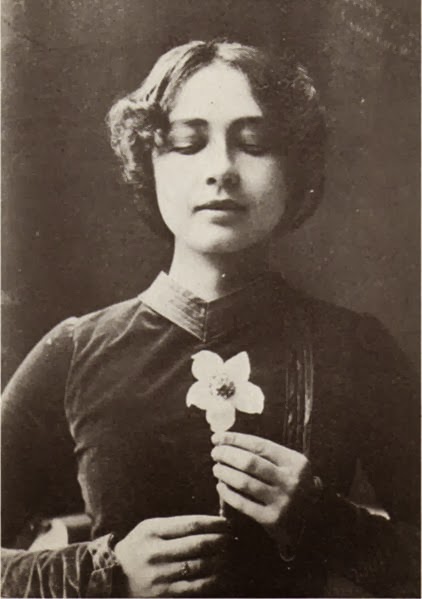
Harriet Sofie Bosse (19 February 1878 – 2 November 1961) was a Swedish – Norwegian actress. A celebrity in her own day, Bosse is today most commonly remembered as the third wife of August Strindberg , an influential playwright. Bosse began her career in a minor company run by her forceful older sister Alma Fahlstrøm in Kristiania (now Oslo , the capital of Norway). Having secured an engagement at the Royal Dramatic Theatre ("Dramaten"), the main drama venue of Sweden's capital Stockholm , Bosse caught the attention of Strindberg with her intelligent acting and exotic "oriental" appearance. After a whirlwind courtship, which unfolds in detail in Strindberg's letters and diary, Strindberg and Bosse were married in 1901, when he was 51 and she 22. Strindberg wrote a number of major roles for Bosse during their short and stormy relationship, especially in 1900–01, a period of great creativity and productivity for him. Like his previous two marriages, the re...

Harriet Bosse in Strindberg's "To Damascus"

Image
  [Photo fro Wikimedia Commons] 

To Damascus

To Damascus ( Swedish : Till Damaskus ), also known as The Road to Damascus , is a trilogy of plays by the Swedish playwright August Strindberg . [1] The first two parts were published in 1898, with the third following in 1904. [2] It has been described as "Strindberg's most complex play" and as "his greatest play," due to its "synthesis of a wide variety of myths, symbols and ideas with a profound spiritual analysis in a new dramatic form." [3] Writing Process Strindberg began writing Part 1 in January 1898 in France and by 8 March he had completed the manuscript. [4] This marked the first time that Strindberg had written drama in five years. [4] "If you find it good," he wrote to Gustaf af Geijerstam , "chuck it in at the theatre. If you find it impossible, hide it away." [4] At this time, he considered the first part to be complete in itself; he did not originally intend to follow it with two sequels. [4] He began w...

Kafka on Strindberg

We are his contemporaries and his successors. One has only to close one's eyes and one's own blood delivers lectures on Strindberg.

From Strindberg's "The Growth of a Soul"

     John had discovered that men in general were automata. All thought the same; all judged in the same fashion; and the more learned they were, the less independence of mind they displayed. This made him doubt the whole value of book education. The graduates who came from Upsala had, one and all, the same opinions on Rafael and Schiller, though the differences in their characters would have led one to expect a corresponding difference in their judgments. Therefore these men did not think, although they called themselves freethinkers, but merely talked and were merely parrots.

Strindberg Quoting La Bruyere

"Don't be angry because men are stupid and bad, or you will have to be angry because a stone falls; both are subject to the same laws; one must be stupid and the other fall."

Strindberg on Buckle

Buckle's History of Civilization in England was written in 1857, but did not reach Sweden till 1871 - 1872. Even then the soil was not ready for the seed. The learned critics were unfavourable to Buckle, and the seed took root only in some young minds who had no authoritative voice.      "No literature," says Buckle himself, "can be useful to a people, if they are not prepared to receive it." Thus it was with Buckle and his work, which preceded that of Darwin (1858) and contained all its inferences -- a proof that evolution in the world of thought is  not so strictly conditioned as has been believed. Buckle did not know Mill or Spencer, whose thoughts rule the world, but he said most of what they said subsequently. 

Henry Thomas Buckle (1821 - 1862)

Henry Thomas Buckle (24 November 1821 – 29 May 1862) was an English historian , author of an unfinished History of Civilization and a very strong amateur chess player. Early Life and Education Buckle was born the son of Thomas Henry Buckle, a wealthy London merchant and shipowner, he was born at Lee in Kent . His delicate health prevented him obtaining much formal education; he never attended university and was little at school. However, he received a high degree of education privately, and the love of reading he felt as a child was given many outlets. He first gained distinction as a chess player, being known, before he was twenty, as one of the best in the world. In matchplay he defeated Kieseritsky and Loewenthal [ 1 ] and was named Chessgames.com player of the day on 11 November 2012. After his father's death in January 1840, he inherited an ample fortune and a large library, and travelled with his mother on the continent (1840–1844). He had by then resolved to di...

Strindberg's John: Anti-Bellmann

     John had an old grudge against this poet. Once as a child, he had been ill for a whole summer, and had by chance taken Bellmann's Fredman's Epistles out of his father's bookcase. The book seemed to him silly, but he was too young to form a well-grounded opinion on it. **    Bellmann's idylls are careless, extemporized compositions with forced rhymes, and as disconnected as the thoughts in the brain of a drunkard. One does not know whether it is day or night, the thunder rolls in the sunshine, and the waves beat while the boat is floating calmly on the waters. They simply provide a text for music, and for that purpose one might use a book of addresses. The meaning of the words does not matter, as long as they sound well.   

Carl Michael Bellmann (1740 - 1795)

Image
Carl Michael Bellman (   listen   ( help · info ) ; 4 February 1740 – 11 February 1795) was a Swedish poet , songwriter , composer and performer. Bellman is a central figure in the Swedish song tradition and remains a powerful influence in Swedish music , as well as in Scandinavian literature , to this day. Bellman is best known for two collections of poems set to music, Fredman's songs ( Fredmans sånger ) and Fredman's epistles ( Fredmans epistlar ). Each consists of about 70 songs. The general theme is drinking, but the songs wonderfully combine words and music to express feelings and moods ranging from humorous to elegiac, romantic to satirical. Bellman's patrons included the King, Gustav III of Sweden , who called him the master improviser. Bellman has been compared to Shakespeare , Beethoven , Mozart , and Hogarth , but his gift, using elegantly baroque classical references in comic contrast to sordid drinking and prostitution, which are at once regretted and ...

From Strindberg's "The Growth of a Soul"

On teaching: The pupil thinks his work hard, but he is only the carriage while the teacher is the horse. Teaching is decidedly harder than standing by a screw or the crane of a machine, and equally monotonous.

From Strindberg's "The Growth of a Soul"

Another of the "autos." He's gone off to college and is also teaching elementary school. *** Re his teaching experience: What it is that makes the competent teacher is not clear. Some produced an effect by their quiet manner, others by their nervousness; some seemed to magnetise the children, others beat them; some imposed on them by their age or their manly appearance, etc. The women worked as women, i.e. through a half-forgotten tradition of a past matriarchate. John was not competent. He looked too young and was only just nineteen; he was skeptical about the methods employed and everything else; with all his seriousness he was playful and boyish. The whole matter to him was only an employment by the way, for he was ambitious and wished to advance, but did not know in which direction. Re writing and talent: John was seized with a craze for writing verse but could not. The gift must be born with one, he thought, and inspiration descend all of a sudden, as i...

From Strindberg's "The Father"

LAURA. Power, yes! What has this whole life and death struggle been for but power? CAPTAIN. To me it has meant more. I do not believe in a hereafter; the child was my future life. That was my conception of immortality, and perhaps the only one that has any analogy in reality. If you take that away from me, you cut off my life. LAURA. Why didn't we separate in time? CAPTAIN. Because the child bound us together; but the link became a chain. And how did it happen; how? I have never thought about this, but now memories rise up accusingly, condemningly perhaps. We had been married two years, and had no children; you know why. I fell ill and lay at the point of death. During a conscious interval of fever I heard voices out in the drawing-room. It was you and the lawyer talking about the fortune that I still possessed. He explained that you could inherit nothing because we had no children, and he asked you if you were expecting to become a mother. I did not hear your reply. I recov...

From Strindberg's "The Father"

Went from Miss Julie to The Father . Haven't researched this hymn fragment (I don't know it), but I enjoyed it. NURSE. Ah, yes, ah yes! [ Reads half aloud ] Ah woe is me, how sad a thing Is life within this vale of tears, Death's angel triumphs like a king, And calls aloud to all the spheres -- Vanity, all is vanity. Yes, yes! Yes, yes! [ Reads again ] All that on earth hath life and breath To earth must fall before his spear, And sorrow, saved alone from death, Inscribes above the mighty bier. Vanity, all is vanity. Yes, Yes.