Posts

Showing posts with the label Enlightenment

Joseph de Maistre

Image
Joseph-Marie, comte de Maistre ( French pronunciation:  [də mɛstʁ] [ 1 ] 1 April 1753 – 26 February 1821) was a French-speaking Savoyard philosopher, writer, lawyer, and diplomat. He was one of the most influential spokesmen for a hierarchical monarchal state in the period immediately following the French Revolution of 1789. Despite his close intellectual and personal ties with France, Maistre remained throughout most of his life a subject of the King of Piedmont-Sardinia , whom he served as member of the Savoy Senate (1787–1792), ambassador to Russia (1803–1817), and minister of state to the court in Turin (1817–1821). [ 2 ] Maistre, one of the key intellectual figures of the Counter-Enlightenment , regarded monarchy as both a divinely sanctioned institution and as the only stable form of government. He called for the restoration of the House of Bourbon to the throne of France and also for the ultimate authority of the Pope over temporal governments. According to Maist...
Isaiah Berlin's "The Counter-Enlightenment"

This passage comes from Isaiah Berlin's anthology of essays titled The Proper Study of Mankind : the essay is "The Counter-Enlightenment" (apparently Berlin is given credit, at least by some, for coining Counter-Enlightenment ):    One of the darkest of the reactionary forms of the fight against the Enlightenment, as well as one of the most interesting and influential, is to be found in the doctrines of Joseph de Maistre and his followers and allies, who formed the spearhead of the counter-revolution in the early nineteenth century in Europe. Maistre held the Enlightenment to be one of the most foolish, as well as the most ruinous, forms of social thinking.The conception of man as naturally disposed to benevolence, co-operation and peace, or, at any rate, capable of being shaped in this direction by appropriate education or legislation, is for him shallow and false. The benevolent Dame Nature of Hume, Holbach and Helvetius is an absurd figment. History and zoology are th...

Enlightenment, Haskalah, and the Dangers of Reason

Image
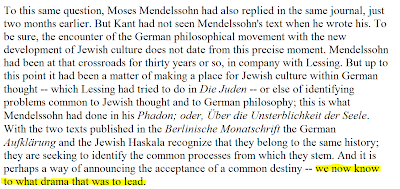
Rereading Foucault's "What is Enlightenment?" I was struck by this observation: * Are there others who think this way and/or are suspicious of Reason? Two passages from Darrin M. McMahon "Sweep of reason" (Boston Globe, June 22, 2003): 

Enlightenment = Aufklarung

Image
From Wikipedia: The term "Enlightenment" came into use in English during the mid-18th century, [2] with particular reference to French philosophy, as the equivalent of a term then in use by German writers, Zeitalter der Aufklärung , signifying officially the philosophical outlook of the 18th century. However, the German term Aufklärung was not merely applied retrospectively; it was already the common term by 1784, when Immanuel Kant published his influential essay Answering the Question: What Is Enlightenment? * First page of Kant's Essay (1799 version) [Wikimedia Commons] * A translation of Michel Foucault's essay "What is Enligtenment?" (which I first found years ago in my Foucault Reader) can be found here:   http://philosophy.eserver.org/foucault/what-is-enlightenment.html It's worth a read (several reads), but I'll just quote Foucault's final sentence here: I do not know whether it must be said today that the critical task...