Posts

Showing posts with the label Tarkovsky

Rereading Roadside Picnic

Rewatched Tarkovsky's Stalker first (found it free on Hulu or somewhere), so I could feel the difference: both great. Excerpt from the book: I come over to them with my glass. Gutalin grabs me by the coat, sits me down at their table, and says, “Sit down, Red! Sit down, servant of Satan! I love you. Let us weep over the sins of humanity—weep in despair!” “Let us weep,” I say. “Swallow the tears of sin.” “Because the day is nigh,” proclaims Gutalin. “Because the pale horse has been saddled, and the rider has put a foot in the stirrup. And futile are the prayers of the worshippers of Satan. And only those who renounce him shall be saved. Thou, of human flesh, whom Satan has seduced, who play with his toys and covet his treasures—I tell thee, thou art blind! Awake, fools, before it’s too late! Stamp on the devil’s baubles!” Here he comes to an abrupt halt, as if forgetting what’s next. “Can I get a drink in this place?” he asks in a different voice. “Where am I? You know, Red, I got f...
Bagno Vignoni (Tuscany)

Bagno Vignoni is an Italian village and hamlet ( frazione ) of San Quirico d'Orcia , situated on a hill above the Val d'Orcia in Tuscany . It is a popular tourist destination and well known for its hot springs. History The ancient village of Bagno Vignoni is located in the heart of Tuscany , in the Val d'Orcia Natural Park . Thanks to the Via Francigena (which was the main route followed by pilgrims in antiquity who went to Rome), these thermal waters were found and have been used since Roman times. At the heart of the village is the "Square of sources", namely a rectangular tank, of sixteenth-century origin, which contains the original source of water that comes from the subterranean aquifer of volcanic origins. Since the Etruscans and Romans - as evidenced by the numerous archaeological finds - the spa of Bagno Vignoni was attended by eminent personalities such as Pope Pius II , Saint Catherine of Siena , Lorenzo the Magnificent and many other artis...

From Tarkovsky's "Nostalghia"

Image
It's been a very long time. I thought the candle bit was in the dark, or at least ending in the dark. Still: unforgettable. *                                               

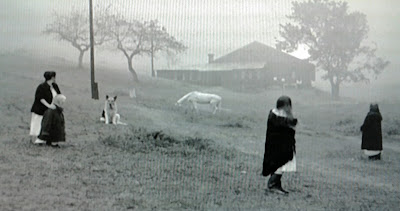
Tarkovsky's "Ivan's Childhood"

Image
Currently reading: FMF: a bio + just started Parade's End (a somewhat garbled Kindle version -- we need a better buying option!). Currently watching: Early Tarkovsky. *                       

Bell-Making I

Image


A Few More Stalker Photos

Image
Freeze a Tarkovsky film, shoot, and you've got near-museum pieces (contra Berger). Not saying my amateur clicks are that, but I'm sure a professional could get there. Anyway, these are just a few shots from Stalker :  

Afterword and the Word "Stalker"

In my Kindle version of Roadside Picnic the text ends on p. 193 and, on the same page, begins an Afterword by Boris Strugatsky. Lots of interesting tidbits here: re the writing and publishing of the novel in Soviet Russia, but I'll only allude to the interesting discussion of the word "stalker": Apparently, the term "stalker" came to us in the process of working on the first pages of the book. As for the "prospectors" and "trappers," we didn't like those terms to begin with; I remember this well.      We were the ones who introduced the English word "stalker" into the Russian language . Stalker --pronounced "stullker" in Russian--is one of the few words we "coined" that came into common use. Stalker spread far and wide, although I'd guess that this was mainly because of the 1979 film of that name, directed by Andrei Tarkovsky and based on our book. . . . It would have been more correct to say ...

"Roadside Picnic" by the Strugatsky Brothers

Temporarily e-shelved Quixote (I'm more than half way through) to quickly read Roadside Picnic  (I want to read it and then re-watch Tarkovsky's Stalker ). Though the book and the film have similarities, I can certainly understand Tarkovsky's quip that they're nothing alike. Also, I probably half-agree with a friend who said she'd put Quixote down because it was too slapstick. I think it's more like: too much of a good thing is a bad thing. But that may also partly be a modern sensibility speaking. Anyway, I won't give up on the brave knight errant (seriously, though it takes some patience: I'm enjoying it), but I want him to rest before getting all banged up again. I'm also enjoying Berger's selected essays: finished those from Toward Reality ( Permanent Red in the UK) and have moved on to those from The Moment of Cubism. The only nits I have thus far are his "seeing things" in paintings and painters (he makes his evaluations soun...

Stalker in the Zone

Image
Stalker in the Zone , a photo by nkimadams on Flickr.

from Tarkovsky's "Stalker"

Image
from Tarkovsky's "Stalker" , a photo by nkimadams on Flickr. Anatoly Solonitsyn (used by Tarkovsky several times) plays "the writer" in Stalker. He is on the left.

Tarkovsky's Death and the Film "Stalker"

Several people involved in the film production — including Tarkovsky — had met deaths, which some crew members attribute to the film's long, arduous shooting schedule in toxic locations. Sound designer Vladimir Sharun recalls: We were shooting near Tallinn in the area around the small river Jägala with a half-functioning hydroelectric station. Up the river was a chemical plant and it poured out poisonous liquids downstream. There is even this shot in Stalker: snow falling in the summer and white foam floating down the river. In fact it was some horrible poison. Many women in our crew got allergic reactions on their faces. Tarkovsky died from cancer of the right bronchial tube. And Tolya Solonitsyn too. That it was all connected to the location shooting for Stalker became clear to me when Larisa Tarkovskaya died from the same illness in Paris. [ 6 ]   [From Wikipedia:   http://en.wikipedia.org/wiki/Stalker_(film )]

Anatoly Solonitsyn (1934 - 1982)

Anatoly Alekseyevich Solonitsyn (also 'Anatoli'; Russian : Анатолий ((Отто)) Алексеевич Солоницын ; 30 August 1934, Bogorodsk – 11 June 1982, Moscow ) was a Soviet actor . Solonitsyn is best known in the west for his roles in several of Andrei Tarkovsky 's films, including Dr. Sartorius in Solaris (1972), the Writer in Stalker (1979), the physician in The Mirror (1975), and the title role in Andrei Rublev (1966). Indeed, it was Tarkovsky who "discovered" him. In his book Sculpting In Time , Tarkovsky calls him his "favorite" actor, and writes that Solonitsyn was intended to play the lead roles in each of his films Nostalghia (1983) and The Sacrifice (1986), but died before their production. In the former Soviet Union he is also well known for his roles in Telokhranitel /The Bodyguard (1979), At Home among Strangers (1974) and many others. In 1981, he won the Silver Bear for Best Actor at the 31st Berlin International Film Festival for...

1969 Andrei Rublev (pol)

Image
1969 Andrei Rublev (pol) , a photo by punainenkyynel on Flickr. The DVD I have (Criterion Collection) has pretty much the same cover design.

Andrei Rublev

OK, so I'm in a Tarkovsky mood. Tarkovsky takes patience but he's well worth the ticket price. I'm re-watching his Andrei Rublev. I'm no movie critic but I'm constantly amazed at what he was able to accomplish. E.g., the initial balloon bit: magical; the horse flipping over and back again (saying nothing and everything). *** Andrei Rublev ( Russian : Андре́й Рублёв ; IPA: [ɐnˈdrʲej rʊˈblʲɵf] , also transliterated Andrey Rublyov and other permutations; [1] born in the 1360s, died 1427 or 29 January 1430) is considered to be the greatest medieval Russian painter of Orthodox icons and frescoes . Biography There is little information about his life. It is not known where he was born. Andrei Rublev probably lived in the Trinity-St. Sergius Lavra near Moscow under Nikon of Radonezh , who became hegumen after the death of Sergii Radonezhsky (1392). The first mention of Rublev is in 1405 when he decorated icons and frescos for the Cathedral of the...

Levitating Margarita Terekhova

Image
tumblr_kqqzl08tVr1qzzf25o1_500 , a photo by sallyspears on Flickr. From Tarkovsky's The Mirror (of course in the film Tarkovsky and the ladder vanish).

Tarkovsky

Image
Tarkovsky , a photo by DEVOLVE on Flickr. A very cool pic (artwork) re Tarkovsky

Watching Tarkovsky's "The Mirror"

Re-watching. I think I watched it a year ago about this time. Or did I watch it over Xmas break 2010? Memory is an unreliable narrator. But haven't I seen it at least three times? The first time (shadow on shadow) was over 20 years ago. * The Mirror The Mirror ( Russian : Зеркало , Zerkalo ; known in the UK as Mirror [2] ) is a 1975 Russian film directed by Andrei Tarkovsky . It is loosely autobiographical, blending childhood memories, newsreel footage and poems by his father Arseny Tarkovsky . The film features Margarita Terekhova , Ignat Daniltsev, Tarkovsky's wife Larisa Tarkovskaya , Alla Demidova and Anatoli Solonitsyn , with a soundtrack by Eduard Artemyev . The Mirror has no apparent plot — instead, it rhythmically combines contemporary scenes with childhood memories and newsreel footage. At various points in the film, poems by Tarkovsky's father are recited. The loose flow of visually oneiric images has been compared to stream of consciousness techni...

"The Sacrifice" by Tarkovsky

Image
The Sacrifice_I , a photo by Rufus.Knight on Flickr. I believe Tarkovsky shot his last film, The Sacrifice , on Bergman's Island. Correction: According to Wiki, Tarkovsky wanted to shoot  The Sacrifice  on Faro but couldn't. Instead he shot the film on nearby Gotland.