Posts

Showing posts with the label DeFoe

Still Reading "Crusoe" & Starting "Foe"

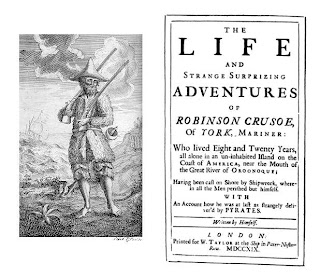
Little more than half way through Robinson Crusoe . Crusoe first saw a single human foot mark; then he saw the body parts. He waffled like crazy re what to do, and then pretty much decided to play defense. Morally he had a hard time playing judge: I debated this very often with myself thus: "How do I know what God Himself judges in this particular case? It is certain these people do not commit this as a crime; it is not against their own consciences reproving, or their light reproaching them; they do not know it to be an offense, and then commit it in defiance of divine justice, as we do in almost all the sins we commit. They think it no more a crime to kill a captive taken in war than we do to kill an ox; or to eat human flesh than we do to eat mutton." *** Just started Coetzee's Foe and already I'm a third through (most of Coetzee's texts are quick reads). The curtain opens with three characters: Susan Barton (she gets thrown up on Cruso's island ...
Crusoe Is in His Eleventh Year

Image
I'm roughly half way through the book and Crusoe is in his eleventh year on the island. He tried to sail around the island but almost got carried out to sea by a strong current. Now he is contemplating the idea of how to raise goats because his ammunition is growing low.    But being now in the eleventh year of my residence, and, as I have said, my ammunition growing low, I set myself to study some art to trap and snare the goats, to see whether I could not catch some of them alive; and particularly I wanted a she-goat great with young. Image from the Wikimedia Commons

James Joyce on "Crusoe"

Apparently in some lectures delivered in Trieste, Italy (1912) Joyce had this to say about DeFoe's Robinson Crusoe and how it reflects the English mindset: . . . the manly independence, the unconscious cruelty, the persistence, the slow but effective intelligence, the sexual apathy, the practical and well-balanced religiosity, the calculating silence [of Robinson Crusoe ]. And further: The true symbol of the British conquest is Robinson Crusoe, cast away on a desert island, in his pocket a knife and a pipe, becomes an architect, a knife-grinder, an astronomer, a baker, a shipwright, a potter, a saddler, a farmer, a tailor, an umbrella-maker, and a clergyman. He is the true prototype of the British colonist, as Friday (the trusty savage who arrives on an unlucky day) is the symbol of the subject races. The whole Anglo-Saxon spirit is in Crusoe. * NB: These quotes are translations from Italian originals. Ergo alternate translations exist. See the following link for further (if ...

Where was Robinson Crusoe?

Image
He had been prospering in Brazil, but had agreed to sail to the coast of Africa (Guinea) to obtain slaves for himself and other plantation owners. By his own account when the storm hits he is around the mouth of the Orinoco River (northeast coast of Venezuela) and within sight of Tobago. This would seem in accord with what he "roughly" reckons later on the island (making use of the autumnal equinox): . . . ; for I reckoned myself, by observation, to be in the latitude of nine degrees twenty-two minutes north of the line. *** Though Crusoe is fiction he may be partly based on a real castaway by the name of Alexander Selkirk. Selkirk was stranded for four years on an island, Mas a Tierra (since renamed Robinson Crusoe Island), off the coast of Chile. Due west of Santiago this island of course does not accord with the details given in the novel.  

DeFoe's "Crusoe" & Coetzee's "Foe"

Image
Finished with Pale Fire . If I wait another 5 to 10 years, I'll have forgotten much of it and it'll read like a brand new story. That's the richness of Nabokov. * Have begun a Kindle version of DeFoe's Robinson Crusoe (I've never read it; never thought to read it until now) as prep/preface to Coetzee's Foe (apparently DeFoe's surname was originally just Foe). I'll read a good chunk of the first before dipping into the second. So far there's a lot about listening to your father and taking the middle path (safer; better chance for happiness) and Crusoe's desire for sailing and adventure, despite the dangers. The only bit I've highlighted in my Kindle thus far is a few interesting lines re Crusoe's observations on mankind, especially youth: --viz. that they are not ashamed to sin, and yet are ashamed to repent; not ashamed of the action for which they ought justly to be estimated fools, but are ashamed of the returning, which only ...