Posts

Showing posts with the label Foucault

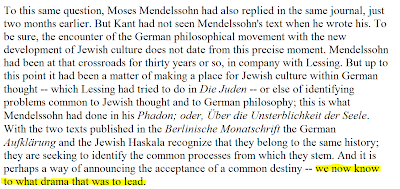
Enlightenment, Haskalah, and the Dangers of Reason

Image
Rereading Foucault's "What is Enlightenment?" I was struck by this observation: * Are there others who think this way and/or are suspicious of Reason? Two passages from Darrin M. McMahon "Sweep of reason" (Boston Globe, June 22, 2003): 

Enlightenment = Aufklarung

Image
From Wikipedia: The term "Enlightenment" came into use in English during the mid-18th century, [2] with particular reference to French philosophy, as the equivalent of a term then in use by German writers, Zeitalter der Aufklärung , signifying officially the philosophical outlook of the 18th century. However, the German term Aufklärung was not merely applied retrospectively; it was already the common term by 1784, when Immanuel Kant published his influential essay Answering the Question: What Is Enlightenment? * First page of Kant's Essay (1799 version) [Wikimedia Commons] * A translation of Michel Foucault's essay "What is Enligtenment?" (which I first found years ago in my Foucault Reader) can be found here:   http://philosophy.eserver.org/foucault/what-is-enlightenment.html It's worth a read (several reads), but I'll just quote Foucault's final sentence here: I do not know whether it must be said today that the critical task...

The Difference: Foucault vs. Chomsky

FOUCAULT:    No, but I don't want to answer in so little time. I would simply say this, that finally this problem of human nature, when put simply in theoretical terms, hasn't led to an argument between us; ultimately we understand each other very well on these theoretical problems.    On the other hand, when we discussed the problem of human nature and political problems, then differences arose between us. And contrary to what you think, you can't prevent me from believing that these notions of human nature, of justice, of the realisation of the essence of human beings, are all notions and concepts which have been formed within our civilisation, within our type of knowledge and our form of philosophy, and that as a result form part of our class system; and one can't, however regrettable it may be, put forward these notions to describe or justify a fight which should-and shall in principle--overthrow the very fundaments of our society. This is an extrapol...
From Coetzee to The Chomsky-Foucault Debates

Can't totally explain the progression of thought (mental gymnastics) that led me to, reminded me of, these debates (which I've never heard or read in toto): prejudice = what we take for granted (Heidegger), the legacy of Socrates = Ventriloquism (Coetzee's Age of Iron ), what "coloured" means in the milieu in which a young Coetzee (or the subject/object of the narrator's gaze in Coetzee's Boyhood ) grows up: . . . Coloured, which means that he has no money, lives in an obscure hovel, goes hungry; it means that if his mother were to call out 'Boy!' and wave, as she is quite capable of doing, this boy would have to stop in his tracks and come and do whatever she might tell him (carry her shopping basket, for instance), and at the end of it get a tickey in his cupped hands and be grateful for it. And if he were angry with his mother afterwards, she would simply smile and say, 'But they are used to it!'  * Anyway, found this debate transcri...

Eliot's "The Waste Land": What Does It Matter Who Is Speaking

Foucault, echoing Beckett: What does it matter who is speaking. This came to mind in re-reading Eliot's first few lines (1-18) of "The Waste Land." And the pronouns "searching for antecedents" in the first few lines are continued and compounded throughout the consciously fragmented text, especially in the last strophe where a string of disembodied voices (from Weston's Fisher King to the Upanishads: Shantih   shantih   shantih) brings the poem to a close. * This morning I will only highlight one of those disembodied voices: Line 430 is a single line from Gerard de Nerval's sonnet El Desdichado ("The Disinherited"): Le Prince d'Aquitaine a la tour abolie . Here is the entire sonnet: El Desdichado I am the man of gloom -- the widower -- the unconsoled, the prince of Aquitaine, his tower in ruins: My sole star is dead -- and my constellated lute bears the Black Sun of Melancholia . In the night of the tomb, you who consoled ...