Posts

Showing posts with the label Vertigo

Vertigo

Not far from the margin of the forest stands the Krummenbach chapel, so small that it can surely not have been possible for more than a dozen to attend a service or worship there at the same time. In that walled cell I sat for a while. Outside, snowflakes were drifting past the small window, and presently it seemed to me as if I were in a boat on a voyage, crossing vast waters. The moist smell of lime became sea air; I could feel the spray on my forehead and the boards swaying beneath my feet, and I imagined myself sailing in this ship out of the flooded mountains. But what I remember most about the Krummenbach chapel, apart from this transformation of the stone walls into the hull of a wooden boat, is the Stations of the Cross, painted by some unskilled hand around the mid-eighteenth century, and half already covered and eaten by mould. Even on the somewhat better preserved scenes, little could be made out with any degree of certainty – faces distorted in pain and anger, dislocated li...

Vertigo

Filled by a sense of having been abandoned, I remained standing for a while on the platform. The girl in the many-coloured jacket and the Franciscan nun had long since disappeared. What connection could there be, I then wondered and now wonder again, between those two beautiful female readers and this immense railway terminus which, when it was built in 1932, outdid all other train stations in Europe; and what relation was there between the so-called monuments of the past and the vague longing, propagated through our bodies, to people the dust-blown expanses and tidal plains of the future.

Giotto and The Arena Chapel

Image
  Scrovegni/Arena Chapel

Vertigo

When I looked up once again from my work, the shadowy forms of the sleepers on the station forecourt had all vanished, or had faded away, and the morning traffic had begun. At one point a barge laden with heaps of rubbish came by. A large rat scuttled along its gunnel and, having reached the bow, plunged head first into the water. I cannot say whether it was the sight of this that made me decide not to stay in Venice but to travel on to Padua instead, without delay, and seek out Enrico Scrovegni’s Arena Chapel. Hitherto all I knew of it was an account that described the undiminished intensity of the colours in Giotto’s frescoes, and the certainty which governs every stride and feature of the figures represented. Once I entered the chapel, from the heat that already prevailed in the city even in the early morning of that day, and stood before the three rows of frescoes that cover the walls up to the ceiling, I was overwhelmed by the silent lament of the angels, who have kept their stati...

Vertigo

Waking up in Venice is unlike waking up in any other place. The day begins quietly. Only a stray shout here and there may break the calm, or the sound of a shutter being raised, or the wing-beat of the pigeons. How often, I thought to myself, had I lain thus in a hotel room, in Vienna or Frankfurt or Brussels, with my hands clasped under my head, listening not to the stillness, as in Venice, but to the roar of the traffic, with a mounting sense of panic. That, then, I thought on such occasions, is the new ocean. Ceaselessly, in great surges, the waves roll in over the length and breadth of our cities, rising higher and higher, breaking in a kind of frenzy when the roar reaches its peak and then discharging across the stones and the asphalt even as the next onrush is being released from where it was held by the traffic lights. For some time now I have been convinced that it is out of this din that the life is being born which will come after us and will spell our gradual destruction, ju...

W. G. Sebald: Vertigo

Ernst declined to eat anything, and instead took one of the cigarettes I offered him. A time or two he appreciatively turned the packet with its English wording in his hands. He inhaled the smoke deeply, with the air of a connoisseur. The cigarette, he had written in one of his poems, is a monopoly and must be smoked. So that it goes up in flames. And, putting down his beer glass after taking a first draught, he observed that he had dreamed about English Boy Scouts last night. What I then told him about England, about the county in East Anglia where I live, the great wheatfields which in the autumn are transformed into a barren brown expanse stretching further than the eye can see, the rivers up which the incoming tide drives the sea water, and the times when the land is flooded and one can cross the fields in boats, as the Egyptians once did – all of this Ernst listened to with the patient lack of interest of a man who has long been familiar with every detail he is being told. I then ...

Sebald: Vertigo: The Last Little Abyss

Idly I turned the pages of an India paper edition of Samuel Pepys’s diary, Everyman’s Library, 1913, which I had purchased that afternoon, and read passages at random in this 1,500-page account, until drowsiness overcame me and I found myself going over the same few lines again and again without any notion what they meant. And then I dreamed that I was walking through a mountainous terrain. A white roadway of finely crushed stone stretched far ahead and in endless hairpins went on and up through the woods and finally, at the top of the pass, led through a deep cutting across to the other side of the high range, which I recognised in my dream as the Alps. Everything I saw from up there was of the same chalky colour, a bright, glaring grey in which a myriad of quartz fragments glimmered, as if the rocks, by a force deep inside them, were being dissolved into radiant light. From my vantage-point the road continued downward, and in the distance a second range of mountains at least as lofty...

W G Sebald: Vertigo

Over the years that followed, lengthy shadows fell upon those autumn days at Riva, which, as Dr K. on occasion said to himself, had been so beautiful and so appalling, and from these shadows there gradually emerged the silhouette of a barque with masts of an inconceivable height and sails dark and hanging in folds. Three whole years it takes until the vessel, as if it were being borne across the waters, gently drifts into the little port of Riva. It berths in the early hours of the morning. A man in blue overalls comes ashore and makes fast the ropes. Behind the boatmen, two figures in dark tunics with silver buttons carry a bier upon which lies, under a large floral-patterned cover, what was clearly the body of a human being. It is Gracchus the huntsman.

W G Sebald: Vertigo

In De l’Amour he describes a journey he claims to have made from Bologna in the company of one Mme Gherardi, whom he sometimes refers to simply as La Ghita. La Ghita, who reappears a number of times on the periphery of Beyle’s later work, is a mysterious, not to say unearthly figure. There is reason to suspect that Beyle used her name as a cipher for various lovers such as Adèle Rebuffel, Angéline Bereyter and not least for Métilde Dembowski, and that Mme Gherardi, whose life would easily furnish a whole novel, as Beyle writes at one point, never really existed, despite all the documentary evidence, and was merely a phantom, albeit one to whom Beyle remained true for decades. It is furthermore unclear at what time in his life Beyle made the journey with Mme Gherardi, always supposing that he made it at all. However, since there is much about Lake Garda in the opening pages of the narrative, it seems probable that some of what Beyle experienced in September 1813, when he was convalescin...

Clip: Sebald: Vertigo

Perhaps prompted by the pitiful pictures in the Krummenbach chapel, my mind turned to Tiepolo once again, and the belief I had held for a long time that, when he travelled with his sons Lorenzo and Domenico from Venice across the Brenner in the autumn of 1750, he decided at Zirl that, contrary to the advice he had been given to leave the Tyrol via Seefeld, he instead made his way westward via Telfs, following the salt wagons across the Gaicht Pass, through the Tannheim valley, over the Oberjoch and through the Iller valley into the lowlands. And I beheld Tiepolo, who must have been approaching sixty by that time and already suffered badly from gout, lying in the cold of the winter months at the top of the scaffolding half a metre below the ceiling of the grand stairway in the palace at Würzburg, his face splattered with lime and distemper, applying the colours with a steady hand, despite the pain in his right arm, onto the wet plaster of the immense, miraculous painting he was cre...

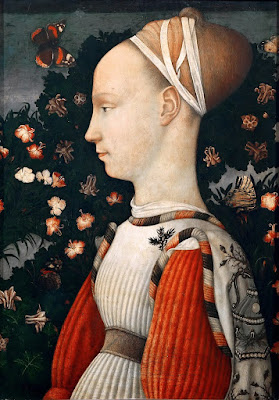
Pisanello (c. 1395 - c. 1455)

Image
Pisanello   (c. 1395 – c. 1455), known professionally as   Antonio di Puccio Pisano   or   Antonio di Puccio da Cereto , also erroneously called   Vittore Pisano   by   Giorgio Vasari , was one of the most distinguished painters of the early   Italian Renaissance   and   Quattrocento . He was acclaimed by poets such as   Guarino da Verona   and praised by humanists of his time, who compared him to such illustrious names as   Cimabue ,   Phidias   and   Praxiteles . Pisanello is known for his resplendent   frescoes   in large murals, elegant portraits, small easel pictures, and many brilliant drawings. He is the most important commemorative portrait   medallist   in the first half of the 15th century, and he can claim to have originated this important genre. [1] He was employed by the Doge of   Venice , the Pope in the   Vatican   and the courts of   Verona , ...

Clips: Sebald: Vertigo

Austerlitz, Emigrants, Rings of Saturn -- now I'm in Vertigo.  Will probably let Mr. Sebald rest after I've finished with Vertigo. Good stuff. Great. Could read him every 5 years or so and it would be like discovering him anew. Writing = Palimpsest. Maybe I'll return to his nonfiction (his work cries for a rubric of its own!) in a bit. *** Later that evening I returned to the bar on the Riva and fell into conversation with a Venetian by the name of Malachio, who had studied astrophysics at Cambridge and, as shortly transpired, saw everything from a great distance, not only the stars. Towards midnight we took his boat, which was moored outside, up the dragon’s tail of the Grand Canal, past the Ferrovia and the Tronchetto, and out onto the open water, from where one has a view of the lights of the Mestre refineries stretching for miles along the coast. Malachio turned off the engine. The boat rose and fell with the waves, and it seemed to me that a long time passed. ...

My On Ramp: VERTIGO, WELCOME TO LA, LA LUZ

Image