Posts

Showing posts with the label Tolstoy

Poor Mary Magdalene

From Tolstoy's Anna Karenina: "Well, you must excuse me there. You know to me all women are divided into two classes…at least no…truer to say: there are women and there are…I've never seen exquisite fallen beings, and I never shall see them, but such creatures as that painted Frenchwoman at the counter with the ringlets are vermin to my mind, and all fallen women are the same." "But the Magdalen?" "Ah, drop that! Christ would never have said those words if He had known how they would be abused. Of all the Gospel those words are the only ones remembered. However, I'm not saying so much what I think, as what I feel. I have a loathing for fallen women. You're afraid of spiders, and I of these vermin. Most likely you've not made a study of spiders and don't know their character; and so it is with me." Note: The pope who wrongly identified Mary Magdalene as a prostitute was Pope Gregory I (also known as Gregory the Great) in the year 59...

Tolstoy: Resurrection: The General

The General belonged to the learned type of military men who believed that liberal and humane views can be reconciled with their profession. But being by nature a kind and intelligent man, he soon felt the impossibility of such a reconciliation; so as not to feel the inner discord in which he was living, he gave himself up more and more to the habit of drinking, which is so widely spread among military men, and was now suffering from what doctors term alcoholism. He was imbued with alcohol, and if he drank any kind of liquor it made him tipsy. Yet strong drink was an absolute necessity to him, he could not live without it, so he was quite drunk every evening; but had grown so used to this state that he did not reel nor talk any special nonsense. And if he did talk nonsense, it was accepted as words of wisdom because of the important and high position which he occupied. Only in the morning, just at the time Nekhludoff came to see him, he was like a reasonable being, could understand wha...

Tolstoy: Resurrection: Worthless Tramp

 "Why don't you pray, old chap?" asked Nekhludoff's driver as he replaced and straightened his cap. "Are you unbaptized?" "Who's one to pray to?" asked the old man quickly, in a determinately aggressive tone. "To whom? To God, of course," said the driver sarcastically. "And you just show me where he is, that god." There was something so serious and firm in the expression of the old man, that the driver felt that he had to do with a strong-minded man, and was a bit abashed. And trying not to show this, not to be silenced, and not to be put to shame before the crowd that was observing them, he answered quickly. "Where? In heaven, of course." "And have you been up there?" "Whether I've been or not, every one knows that you must pray to God." "No one has ever seen God at any time. The only begotten Son who is in the bosom of the Father he hath declared him," said the old man in the sam...

Tolstoy's Resurrection

I shall tell her, Katusha, that I am a scoundrel and have sinned towards her, and will do all I can to ease her lot. Yes, I will see her, and will ask her to forgive me. "Yes, I will beg her pardon, as children do." . . . He stopped---"will marry her if necessary." He stopped again, folded his hands in front of his breast as he used to do when a little child, lifted his eyes, and said, addressing some one: "Lord, help me, teach me, come enter within me and purify me of all this abomination." He prayed, asking God to help him, to enter into him and cleanse him; and what he was praying for had happened already: the God within him had awakened his consciousness. He felt himself one with Him, and therefore felt not only the freedom, fulness and joy of life, but all the power of righteousness. All, all the best that a man could do he felt capable of doing.

Tolstoy's Resurrection

Nekhludoff looked at the prisoners. They whose fate was being decided still sat motionless behind the grating in front of the soldiers. Maslova was smiling. Another feeling stirred in Nekhludoff's soul. Up to now, expecting her acquittal and thinking she would remain in the town, he was uncertain how to act towards her. Any kind of relations with her would be so very difficult. But Siberia and penal servitude at once cut off every possibility of any kind of relations with her. The wounded bird would stop struggling in the game-bag, and no longer remind him of its existence.

Rereading Tolstoy's Kreutzer Sonata

"I was beside myself. I accused her of indelicacy. She made the same accusation against me, and the dispute broke out. In her words, in the expression of her face, of her eyes, I noticed again the hatred that had so astonished me before. With a brother, friends, my father, I had occasionally quarrelled, but never had there been between us this fierce spite. Some time passed. Our mutual hatred was again concealed beneath an access of sensual desire, and I again consoled myself with the reflection that these scenes were reparable faults. "But when they were repeated a third and a fourth time, I understood that they were not simply faults, but a fatality that must happen again. I was no longer frightened, I was simply astonished that I should be precisely the one to live so uncomfortably with my wife, and that the same thing did not happen in other households. I did not know that in all households the same sudden changes take place, but that all, like myself, imagine that it is ...

Tolstoy's "Ivan Ilyich": Clips

The progress of his disease was so gradual that he could deceive himself when comparing one day with another-the difference was so slight. But when he consulted the doctors it seemed to him that he was getting worse, and even very rapidly. Yet despite this he was continually consulting them. That month he went to see another celebrity, who told him almost the same as the first had done but put his questions rather differently, and the interview with this celebrity only increased Ivan Ilych's doubts and fears. A friend of a friend of his, a very good doctor, diagnosed his illness again quite differently from the others, and though he predicted recovery, his questions and suppositions bewildered Ivan Ilych still more and increased his doubts. A homeopathist diagnosed the disease in yet another way, and prescribed medicine which Ivan Ilych took secretly for a week. But after a week, not feeling any improvement and having lost confidence both in the former doctor's treatment an...

Walking: 12/20/18

Image
Caught a great sunrise @ Lagoon. Tried out the new PHILZ on 2nd Street for coffee. Great coffee but a bit pricey. Finished the Thistle = Hadji Murad and have moved on to Tolstoy's Death of Ivan Ilyich . Walked to the Belmont Pier and along the beach. Passed Danny on the walking path. *

Reading: Late Tolstoy

From Confessions : At twenty-six years of age [Footnote: He was in fact 27 at the time.] I returned to Petersburg after the war, and met the writers. They received me as one of themselves and flattered me. And before I had time to look round I had adopted the views on life of the set of authors I had come among, and these views completely obliterated all my former strivings to improve - they furnished a theory which justified the dissoluteness of my life. The view of life of these people, my comrades in authorship, consisted in this: that life in general goes on developing, and in this development we - men of thought - have the chief part; and among men of thought it is we - artists and poets - who have the greatest influence. Our vocation is to teach mankind. And lest the simple question should suggest itself: What do I know, and what can I teach? It was explained in this theory that this need not be known, and that the artist and poet teach unconsciously. I was considered an a...

From Tolstoy's "Kreutzer"

Two bits: "So we lived in the city. In the city the wretched feel less sad. One can live there a hundred years without being noticed, and be dead a long time before anybody will notice it. People have no time to inquire into your life. All are absorbed. Business, social relations, art, the health of children, their education. And there are visits that must be received and made; it is necessary to see this one, it is necessary to hear that one or the other one. In the city there are always one, two, or three celebrities that it is indispensable that one should visit." *** "Thus we passed two years more. The method prescribed by the rascals had evidently succeeded. My wife had grown stouter and handsomer. It was the beauty of the end of summer. She felt it, and paid much attention to her person. She had acquired that provoking beauty that stirs men. She was in all the brilliancy of the wife of thirty years, who conceives no children, eats heartily, and is excite...

Rereading Tolstoy's "Kreutzer Sonata"

Think whatever you like of Tolstoy. Late Tolstoy: old crank, crackpot, seer? A little bit of everything, like all of us. Still, one thing he saw clearly: we are a mess. I was having a hard time "settling in" to the next read: then I landed in Tolstoy's Kreutzer Sonata . Though a bit dated -- what would he have turned his attention to now? -- much of it still rings true. I fall for almost anything beginning or ending with a train.:) * Two bits: "Well, I am going then to tell you my life, and my whole frightful history,--yes, frightful. And the story itself is more frightful than the outcome." He became silent for a moment, passed his hands over his eyes, and began:-- "To be understood clearly, the whole must be told from the beginning. It must be told how and why I married, and what I was before my marriage. First, I will tell you who I am. The son of a rich gentleman of the steppes, an old marshal of the nobility, I was a University pupil, a gra...

Tolstoy in the Park

Image
Not really. For two days in a row I saw a homeless person impersonating Tolstoy. Once he was sitting and having his breakfast. Another time he was just walking through the park. I imagined Tolstoy in the park. *** 

Sochi 2014: Opening Ceremony: Nabokov

Sure there were lots of other "biggies" (and big things), but I guess it was nice to see that Nabokov was a letter in the Cyrillic alphabet. Would he have been OK with that -- or shouted POSHLOST???? No idea. Maybe if I reread "The Vane Sisters" I'll get a hint.

Another Connection Between Tolstoy and Rousseau

From Emile :      The indifference of children towards meat is one proof that the taste for meat is unnatural; their preference is for vegetable foods, such as milk, pastry, fruit, etc. Beware of changing this natural taste and making children flesh-eaters, if not for their health's sake, for the sake of their character; for how can one explain away the fact that great meat-eaters are usually fiercer and more cruel than other men; this has been recognised at all times and in all places. The English are noted for their cruelty [Footnote: I am aware that the English make a boast of their humanity and of the kindly diposition of their race, which they call "good-natured people;" but in vain do they proclaim this fact; no one else says it of them.]

Tolstoy's "Hadji Murat"

Hadji Murat (or alternatively Hadji Murad , Turkish : Hacı Murat , although the first spelling better captures the original title in Russian : Хаджи-Мурат [ Khadzhi-Murat ]) is a short novel written by Leo Tolstoy from 1896 to 1904 and published posthumously in 1912 (though not in full until 1917). It is Tolstoy’s final work. The protagonist is Hadji Murat, an Avar rebel commander who, for reasons of personal revenge, forges an uneasy alliance with the Russians he had been fighting. Inspiration Tolstoy seems to have first heard of the historical Hadji Murad while he was serving in the Caucasus , according to letters he wrote to his brother Sergei. The thistle described at the opening of the story was actually encountered by Tolstoy near his country estate and led him to remember the character and create a story about him. The theme of struggle while remaining faithful resonated with Tolstoy even though he was in ailing health; later letters suggest this work gave him a brief,...

From "Emile"

Almost certain Tolstoy had imbided a little Rousseau (may look up the influences later) before he voiced a "cure" for Moscow's prostitutes (did I read it in his letters or Wilson's bio?): Take them out of the corrupting city and put them in the country. Anyway, here's a bit of Rousseau on the ill effects of the city:      Men are not made to be crowded together in ant-hills, but scattered over the earth to till it. The more they are massed together, the more corrupt they become. Disease and vice are the sure results of over-crowded cities. Of all creatures man is least fitted to live in herds. Huddled together like sheep, men would very soon die. Man's breath is fatal to his fellows. This is literally as well as figuratively true. 

Milan Kundera's "The Curtain"

Pretty much finished with the selection of Pinter's plays (volume 4): just a few more pages of Family Voices . Started Kundera's The Curtain (forgot that I had it). It's subtitled An Essay in Seven Parts . I read his The Art of the Novel years ago; and a big chunk of his fiction years before that. Haven't gotten too far into it yet (though like many of his recent books, it's a shorty), but I thoroughly enjoyed "The Beauty of Death" which starts with the question: "Why does Anna Karenina kill herself?" and compares Tolstoy and Joyce: "Tolstoy and Joyce were haunted by the same obsession: to seize what occurs in a person's head during a present moment and a moment later will be gone forever. But there is a difference: with his interior monologue, Tolstoy examines not, as Joyce will do later, an ordinary, banal day, but instead the decisive moments of his heroine's life. And that is much harder, for the more dramatic, unusual, grave...

Tolstoy's "Anna Karenina" -- Wright's Version More Artifice Than Art

The stage/world thing intrigued me for about a minute (I kept hoping for that trick to disappear but it never did). At some point I wondered if I wasn't watching a spoof on Anna. I guess I'll have to wait some more (or check out the other versions I haven't seen -- that'll keep me busy) -- or better yet: just reread the perhaps unfilmable masterpiece again. It's on my list. *** Forget the glossing over of Levin's essential intellectual meanderings, how can you film this?      She looked at the lower part of the carriages, at the screws and chains and the tall cast-iron wheel of the first carriage slowly moving up, and trying to measure the middle between the front and back wheels, and the very minute when that middle point would be opposite her.      "There," she said to herself, looking into the shadow of the carriage, at the sand and coal dust which covered the sleepers--"there, in the very middle, and I will punish him and es...

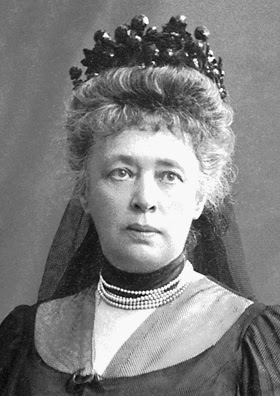
Bertha von Suttner (1843 - 1914)

Image
In The Man Without Qualities she's mentioned in the same breath as Tolstoy: Take Tolstoy, for instance, and Bertha Suttner, two writers whose ideas were equally discussed at the time -- but now, Diotima thought, can mankind even have a roast chicken without violence?   ***     Bertha Felicitas Sophie Freifrau von Suttner (Baroness Bertha von Suttner , Gräfin (Countess) Kinsky von Wchinitz und Tettau; 9 June 1843 – 21 June 1914) was an Austrian novelist, radical (organizational) pacifist , and the first woman to be a Nobel Peace Prize laureate.   Biography  Suttner was born in Prague , Bohemia , the daughter of an impoverished [ 1 ] Austrian Field Marshal, Franz-Josef Graf Kinsky von Wchinitz und Tettau, and wife Sophie von Körner, and governess to the wealthy Suttner family from 1873. She had an older brother, Arthur Franz Graf Kinsky von Wchinitz und Tettau. She became engaged to engineer and novelist Arthur Gundaccar Freiherr von Suttner (...